
Type 7: Entirely Liquid
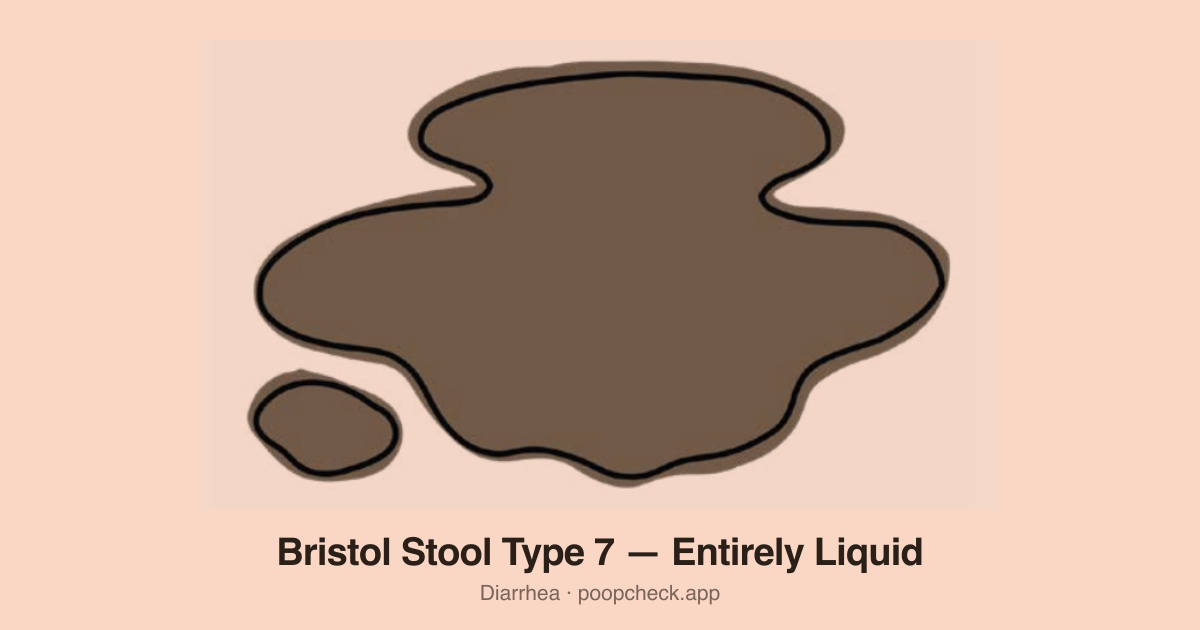
Completely liquid with no solid pieces. Watery.
What Type 7: Entirely Liquid means
Type 7 is full diarrhea. Very rapid transit means water isn't absorbed at all. Acute Type 7 is usually self-limiting but warrants hydration; persistent Type 7 needs medical attention.
- Transit time is very fast — essentially no colonic water absorption.
- Dehydration risk is real, especially for children and the elderly.
- If persistent, can indicate infection, IBD flare, or severe food poisoning.
Common causes
- Acute infection (viral, bacterial, parasitic)
- Food poisoning
- IBD flare (Crohn's, ulcerative colitis)
- Severe IBS-D episode
- Certain medications or chemotherapy
When to see a doctor
- Type 7 lasting more than 48 hours in adults.
- Any Type 7 in infants, elderly, or immunocompromised.
- Blood in stool, high fever (>38.5°C / 101°F), severe abdominal pain.
- Signs of dehydration: dark urine, dizziness, rapid heartbeat, no urination for 8+ hours.
- Recent travel to a developing region.
PoopCheck is a tracker and classifier, not a replacement for medical care. If you see any red flags above, see a qualified clinician.
How to shift toward the healthy range (Type 3–4)
- Oral rehydration solution is the priority — water alone doesn't replace lost electrolytes.
- Avoid dairy, caffeine, alcohol, and high-fat foods until stool firms up.
- Avoid anti-diarrheal medications if you suspect infection — they can trap pathogens.
- Seek medical care if any red-flag symptom appears (see above).
Foods commonly associated with Entirely liquid stool
- Type 7 is usually caused by an acute trigger, not chronic diet.
Neighbors on the Bristol scale
- Type 6: Mushy with Ragged Edges — mild diarrhea.
Related guides
- diarrhea causes and when to worry — Full guide on when diarrhea becomes a medical issue.
FAQ
Is Type 7 (Entirely Liquid normal?
Type 7: Entirely Liquid falls outside the ideal range (Types 3–4). Occasional episodes are common, but consistent Type 7: Entirely Liquid for more than a few weeks — or combined with other symptoms — deserves attention.
What causes Entirely liquid stool?
Acute infection (viral, bacterial, parasitic); Food poisoning; IBD flare (Crohn's, ulcerative colitis). See the full list above with citations.
When should I see a doctor about Entirely liquid stool?
Type 7 lasting more than 48 hours in adults. Also: Any Type 7 in infants, elderly, or immunocompromised. See a healthcare provider for any of these.
How can I shift toward Type 3 or 4?
Oral rehydration solution is the priority — water alone doesn't replace lost electrolytes.; Avoid dairy, caffeine, alcohol, and high-fat foods until stool firms up.; Avoid anti-diarrheal medications if you suspect infection — they can trap pathogens.. These are starting points — persistent issues deserve a clinician evaluation.
Sources
- Stool Form Scale as a Useful Guide to Intestinal Transit Time — Lewis SJ, Heaton KW (1997)
- Bristol Stool Chart: Types & What They Mean — Cleveland Clinic
- Diarrhoea and vomiting — NHS
Track your Bristol type automatically
PoopCheck classifies your stool by Bristol type, color, and consistency from a single photo — and shows the pattern over time.
Download Free