
Type 1: Separate Hard Lumps
Small, hard, separate lumps that look like nuts or rabbit droppings.
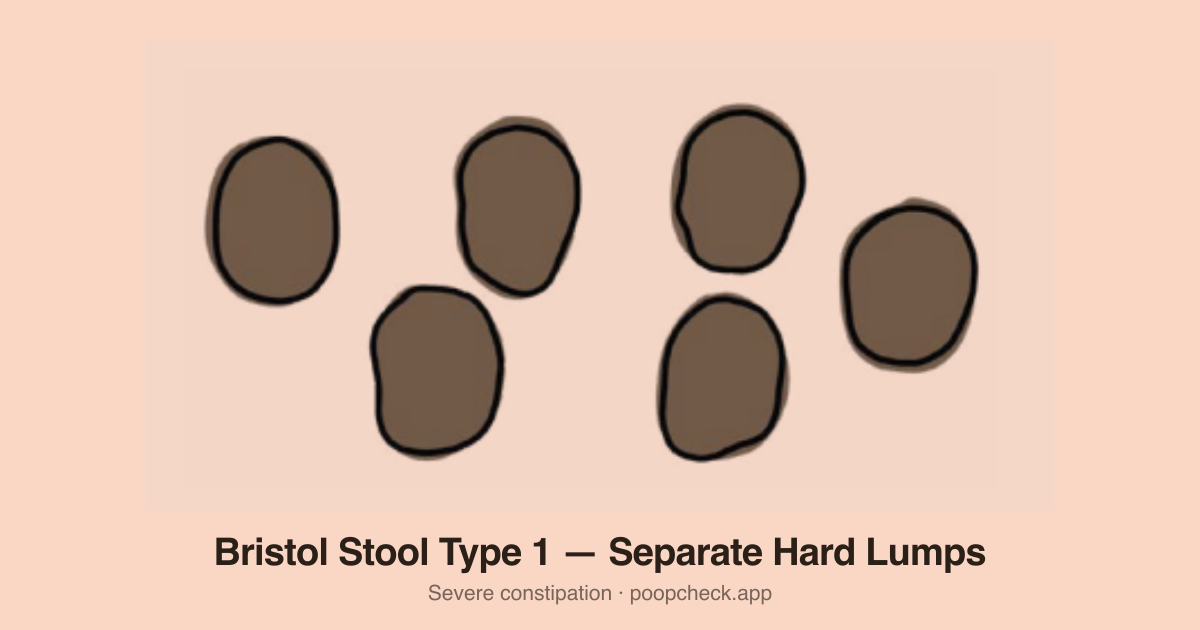
What Type 1: Separate Hard Lumps means
Type 1 on the Bristol Stool Scale is the hardest and driest stool pattern. The stool has spent too long in the colon, where excess water has been reabsorbed through the colon wall, leaving small dehydrated pellets that are painful to pass.
- Transit time through the colon is significantly longer than healthy.
- Water content in the stool is very low — the colon has absorbed most of it.
- Passing Type 1 stool is usually effortful and can cause straining, hemorrhoids, or anal fissures.
- Chronic Type 1 output (multiple days per week for 3+ months) meets Rome IV criteria for chronic constipation.
Common causes
- Low fiber intake (below ~14 g per 1,000 kcal)
- Insufficient fluid intake
- Low physical activity / sedentary lifestyle
- Certain medications (opioids, iron supplements, some antidepressants, anticholinergics)
- Ignoring the urge to go (over time retrains bowel habit)
When to see a doctor
- Type 1 for more than 3 weeks despite diet/fluid changes.
- Accompanied by blood in stool, unexplained weight loss, or severe abdominal pain.
- New-onset in anyone over 45 without an obvious cause.
- Anyone with a family history of colon cancer or IBD experiencing a sustained change in bowel habit.
PoopCheck is a tracker and classifier, not a replacement for medical care. If you see any red flags above, see a qualified clinician.
How to shift toward the healthy range (Type 3–4)
- Increase fiber gradually — 2–3 g per day every few days, up to ~25 g (women) or ~34 g (men) daily
- Drink more water — fiber without fluid can worsen constipation
- Move daily — walking 30 minutes improves colon motility
- Don't ignore the urge — establish a morning routine when the gastrocolic reflex is strongest
- Consider psyllium (5–10 g/day) — normalizes stool in both constipation and diarrhea
Foods commonly associated with Separate hard lumps stool
- Diets heavy in refined carbs, low in plants.
- Low-residue or all-meat eating patterns.
- Dehydration from high caffeine or alcohol with little water.
Neighbors on the Bristol scale
- Type 2: Lumpy and Sausage-Shaped — less severe end of the constipation range.
Related guides
- constipation causes and remedies — Deep dive into constipation, when it's medical.
- fiber and stool consistency — How soluble vs insoluble fiber changes outcomes.
FAQ
Is Type 1 (Separate Hard Lumps normal?
Type 1: Separate Hard Lumps falls outside the ideal range (Types 3–4). Occasional episodes are common, but consistent Type 1: Separate Hard Lumps for more than a few weeks — or combined with other symptoms — deserves attention.
What causes Separate hard lumps stool?
Low fiber intake (below ~14 g per 1,000 kcal); Insufficient fluid intake; Low physical activity / sedentary lifestyle. See the full list above with citations.
When should I see a doctor about Separate hard lumps stool?
Type 1 for more than 3 weeks despite diet/fluid changes. Also: Accompanied by blood in stool, unexplained weight loss, or severe abdominal pain. See a healthcare provider for any of these.
How can I shift toward Type 3 or 4?
Increase fiber gradually — 2–3 g per day every few days, up to ~25 g (women) or ~34 g (men) daily; Drink more water — fiber without fluid can worsen constipation; Move daily — walking 30 minutes improves colon motility. These are starting points — persistent issues deserve a clinician evaluation.
Sources
- Stool Form Scale as a Useful Guide to Intestinal Transit Time — Lewis SJ, Heaton KW (1997)
- Bristol Stool Chart: Types & What They Mean — Cleveland Clinic
- Constipation — NHS
Track your Bristol type automatically
PoopCheck classifies your stool by Bristol type, color, and consistency from a single photo — and shows the pattern over time.
Download Free