
Type 3: Sausage-Shaped with Cracks
Like a sausage but with cracks on the surface. Holds together, passes smoothly.
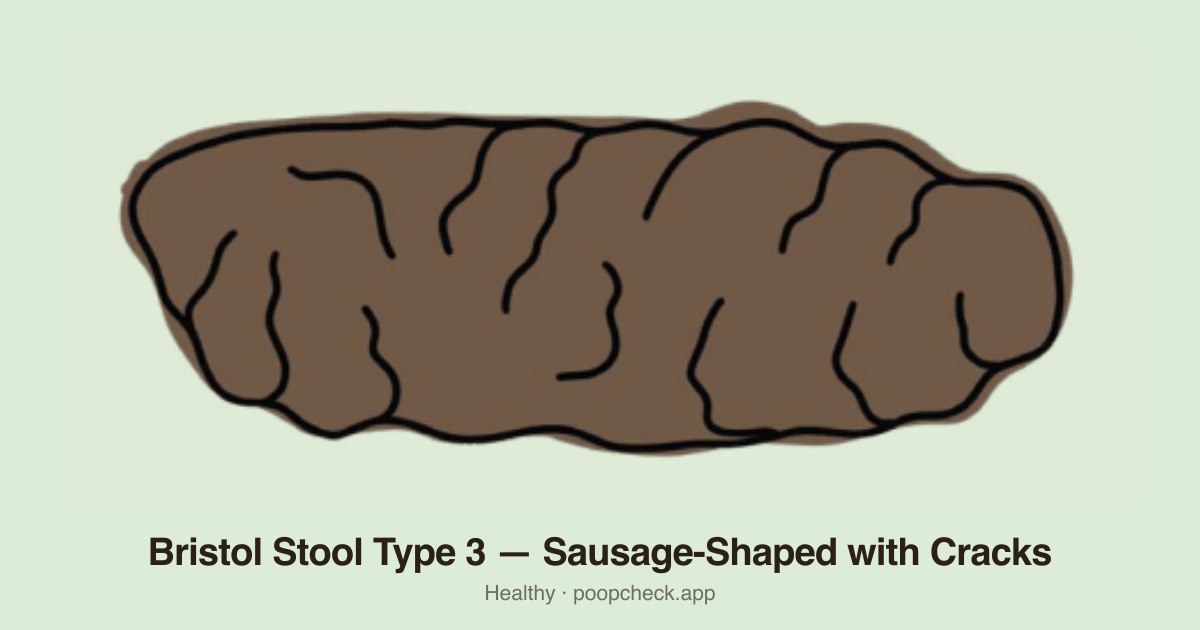
What Type 3: Sausage-Shaped with Cracks means
Type 3 is considered a healthy stool type on the Bristol Stool Scale. Transit time through the colon is appropriate, water content is balanced, and passage is generally easy. Most people aim for Type 3 or Type 4.
- Colon transit time is within the healthy range.
- Diet and hydration are generally supporting good digestion.
- Passing is typically easy and complete.
Common causes
- Adequate fiber intake (25–35 g/day)
- Good hydration
- Regular physical activity
When to see a doctor
- Type 3 isn't itself a concern. See a doctor only if accompanied by blood, mucus, pain, or a sudden shift from your usual pattern.
PoopCheck is a tracker and classifier, not a replacement for medical care. If you see any red flags above, see a qualified clinician.
How to shift toward the healthy range (Type 3–4)
- Maintain — don't over-optimize. Track consistency over weeks to spot drift.
- Note what days you produce Type 3 vs Type 4 — patterns reveal which foods/habits work best for you.
Foods commonly associated with Cracked sausage stool
- Plant-rich diets.
- Balanced protein/carb/fat.
- Fermented foods (yogurt, kefir, kimchi, sauerkraut).
Neighbors on the Bristol scale
- Type 2: Lumpy and Sausage-Shaped — mild constipation side.
- Type 4: Smooth and Snake-Like — ideal / gold standard.
Related guides
- how to improve gut health — Habits that produce consistent Type 3/4 output.
- top fermented beverages to enhance your gut health naturally — Foods that support this pattern.
FAQ
Is Type 3 (Sausage-Shaped with Cracks normal?
Yes. Type 3: Sausage-Shaped with Cracks is within the healthy range on the Bristol Stool Scale.
What causes Cracked sausage stool?
Adequate fiber intake (25–35 g/day); Good hydration; Regular physical activity. See the full list above with citations.
When should I see a doctor about Cracked sausage stool?
Type 3 isn't itself a concern. See a doctor only if accompanied by blood, mucus, pain, or a sudden shift from your usual pattern. See a healthcare provider for any of these.
How can I shift toward Type 3 or 4?
Maintain — don't over-optimize. Track consistency over weeks to spot drift.; Note what days you produce Type 3 vs Type 4 — patterns reveal which foods/habits work best for you.. These are starting points — persistent issues deserve a clinician evaluation.
Sources
- Stool Form Scale as a Useful Guide to Intestinal Transit Time — Lewis SJ, Heaton KW (1997)
- What to know about your poop — Mayo Clinic
- Bristol Stool Chart: Types & What They Mean — Cleveland Clinic
Track your Bristol type automatically
PoopCheck classifies your stool by Bristol type, color, and consistency from a single photo — and shows the pattern over time.
Download Free